Seasonal checklists
Draught Proofing Your Newcastle Home Before Winter
Doors, windows, loft hatches and letterboxes: a practical guide to stopping draughts in your Newcastle home without blocking the ventilation it needs.
Your TV fitted level and secure, with fixings chosen for your wall and cables tidied neatly.
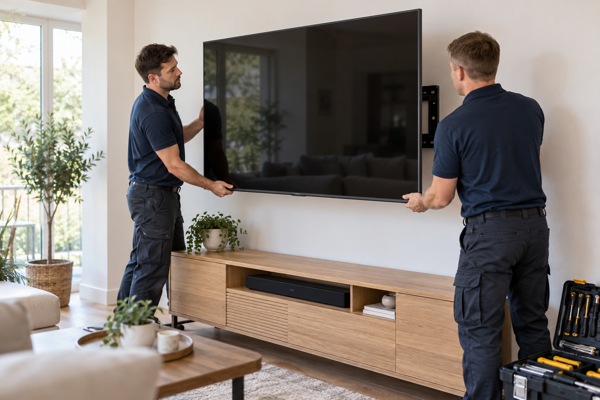
A wall-mounted TV frees up floor space, keeps the screen out of reach of small children and pets, and usually looks far tidier than a unit crowded with boxes. Getting it right is about more than drilling four holes. The bracket has to suit the TV's weight and fixing pattern, the wall has to be able to take the load, and the height needs to be comfortable from where you actually sit.
Handy Andrew mounts TVs in homes and rentals across Newcastle, from compact bedroom screens in Heaton flats to large living-room sets in Gosforth and North Tyneside. Andrew checks the wall type, uses fixings rated for it, checks for hidden pipes and cables before drilling, and makes sure everything is level before the TV goes up.
Cables are tidied using surface trunking or low-voltage cable covers, painted to match if you like. Mains power cables are not buried inside walls, and if you want a socket moved behind the TV, that needs a qualified electrician. Andrew can work alongside your electrician or fit the TV once their work is finished.
Most walls can hold a TV safely if the right fixings are used, but each type needs a different approach:
If a wall is not up to the job, you will be told before anything is drilled, along with the alternatives.
Dangling cables are the main thing people want gone, but how they are hidden matters. Mains power cables should not simply be pushed into a wall cavity or chased into plaster without proper electrical work, so Andrew uses surface options that are safe and easy to access later:
If you want a socket installed behind the screen for a truly cable-free look, that is fixed electrical work and must be done by a qualified electrician. Many customers book their electrician first and then have the TV mounted afterwards.
A common mistake is mounting the TV too high, especially above a fireplace, which leaves you looking up at it for hours. As a rough guide, the middle of the screen should be close to eye level when you are seated. Andrew can hold up a template or mark the wall so you can check the position before drilling.
Fixed brackets sit closest to the wall and suit most living rooms. Tilting brackets help reduce glare or work when a TV has to sit higher. Full-motion arms let you angle the screen towards different seats but place more load on the wall, so they need the strongest fixings. Check your TV's VESA pattern and weight when buying a bracket, or send the model number and Andrew can advise.
Low-voltage leads can sometimes be routed neatly, but mains power cables should not be buried in walls without proper electrical work. Andrew uses surface trunking and cable covers instead. If you want a socket behind the TV, a qualified electrician needs to install it, and the TV can be mounted once that is done.
You can supply your own or ask Andrew to source one. If you are buying it, check it matches your TV's VESA hole pattern and is rated well above the TV's weight. Sending the model number before you buy means you can be told which type suits your wall and room.
Often yes. The best option is fixing into the studs behind the plasterboard. Where that is not possible, heavy-duty cavity fixings can work for lighter TVs on fixed brackets. Large TVs on full-motion arms put more strain on the wall, so in some cases a different position is recommended.
It can be, as long as the chimney breast is sound and there is no excessive heat rising from a fire below. The bigger issue is usually viewing height, which can be uncomfortable. A tilting bracket helps. If you have a working fire, check your TV manufacturer's guidance on heat.
Yes. Andrew can remove a TV and bracket before you decorate, fill the old holes and refit everything afterwards, either in the same position or somewhere new. It is a common request when people are painting a room or moving furniture around.
Tell Andrew what needs fixing – send a couple of photos and you’ll get a clear quote. One visit can sort several small jobs.
Doors, windows, loft hatches and letterboxes: a practical guide to stopping draughts in your Newcastle home without blocking the ventilation it needs.
The common repairs to sort between tenants, how to use inventory photos, and tips for student lets in Jesmond and Heaton. A practical checklist for landlords.
Brick, block, plasterboard or a Tyneside flat partition wall? How to tell what your wall is made of, which bracket suits it and how to tidy the cables safely.
Black mould, gaps and peeling silicone are signs your bath or shower needs resealing. Learn why mould returns, how long sealant takes to cure and when to worry.
Storm damage to your shed roof? How to decide between a patch repair and full re-felting, plus what to check on boards, doors and the base.
Curtain poles, blinds, TV mounting, flatpack and furniture anchors: the handyman jobs worth booking in your first week after moving in.