
Seasonal checklists
Draught Proofing Your Newcastle Home Before Winter
Doors, windows, loft hatches and letterboxes: a practical guide to stopping draughts in your Newcastle home without blocking the ventilation it needs.
Poles, tracks and blinds fitted straight and secure, even in tricky bay windows and old plaster.
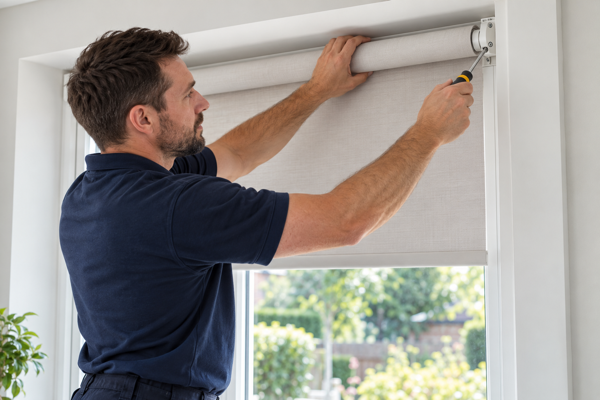
Fitting a blind or curtain pole looks simple until you find the drill skating off a concrete lintel, the plaster crumbling around the plug, or the bracket landing right where a cable might be. Get it slightly wrong and blinds sit crooked, poles sag in the middle, or the whole lot pulls out of the wall when someone yanks a curtain.
Handy Andrew fits blinds, curtain poles and curtain tracks across Newcastle, from new-build homes in North Tyneside to Victorian and Edwardian houses in Jesmond and Gosforth, where window reveals and plaster can be unpredictable. Andrew measures carefully, checks for cables and pipes, uses fixings suited to the wall, and makes sure everything is level before the final screws go in.
It is a popular job for people who have just moved house, landlords replacing broken blinds between tenancies, and anyone who has bought blinds online and wants them fitted properly. Andrew can fit products you have bought or advise on measuring before you order, and can also take down old poles and fill the holes.
Blinds can be fitted inside the window recess, sitting neatly within the reveal, or outside it, covering the window and some wall around it. Inside-recess fitting looks tidy but needs accurate measuring and enough depth for the blind and handles. Outside-recess fitting lets in less light around the edges and is often better for blackout blinds in bedrooms.
Things that affect the choice:
If you have not ordered yet, Andrew can measure up so you buy the right size first time.
Bay windows are common in Newcastle's older terraces and semis, and they are the trickiest windows to dress. A curtain track can be bent to follow the bay, or you can use a bay pole with angled joints. Blinds are often fitted as separate units on each pane, which means lining them up carefully so they sit at the same height.
Walls bring their own problems. Steel lintels can be hard to drill and may need fixing into the frame or ceiling instead. Concrete lintels need the right masonry bit and patience. Old lath and plaster can crumble, so fixings may need to reach solid material behind. Andrew checks before drilling and will suggest a ceiling-mounted track or a different bracket if the wall will not hold a standard fitting.
Yes. Most jobs involve customer-supplied blinds and poles. Before the visit, check that all brackets and screws are in the box, as some come with fixings unsuitable for certain walls. Andrew brings a range of plugs and screws to suit different wall types.
Yes. Measuring is where most problems start, especially for inside-recess blinds in older houses where reveals are not square. Andrew can measure and note the sizes and fixing positions so you can order with confidence, and then come back to fit them.
Usually the plugs were too small for the wall, the plaster behind is crumbly, or the pole is too long without a centre support. The fix is normally refitting with suitable fixings into solid material and adding a middle bracket for longer poles. The old holes can be filled and painted.
In some cases, yes, using brackets designed to fit onto the frame or the window beading. Drilling into uPVC frames needs care so the frame or seal is not damaged, so Andrew will check the frame and the blind type first and advise on the best option.
Looped cords can be a hazard for young children. Blinds should be fitted with cord cleats or tensioners that keep cords out of reach, and many new blinds come with these. Andrew fits them as part of the job and can add them to existing blinds too.
Tell Andrew what needs fixing – send a couple of photos and you’ll get a clear quote. One visit can sort several small jobs.
Doors, windows, loft hatches and letterboxes: a practical guide to stopping draughts in your Newcastle home without blocking the ventilation it needs.
The common repairs to sort between tenants, how to use inventory photos, and tips for student lets in Jesmond and Heaton. A practical checklist for landlords.
Brick, block, plasterboard or a Tyneside flat partition wall? How to tell what your wall is made of, which bracket suits it and how to tidy the cables safely.
Black mould, gaps and peeling silicone are signs your bath or shower needs resealing. Learn why mould returns, how long sealant takes to cure and when to worry.
Storm damage to your shed roof? How to decide between a patch repair and full re-felting, plus what to check on boards, doors and the base.
Curtain poles, blinds, TV mounting, flatpack and furniture anchors: the handyman jobs worth booking in your first week after moving in.