
Seasonal checklists
Draught Proofing Your Newcastle Home Before Winter
Doors, windows, loft hatches and letterboxes: a practical guide to stopping draughts in your Newcastle home without blocking the ventilation it needs.
Doors that hang straight, drawers that glide and handles that stay put, without replacing the whole kitchen.
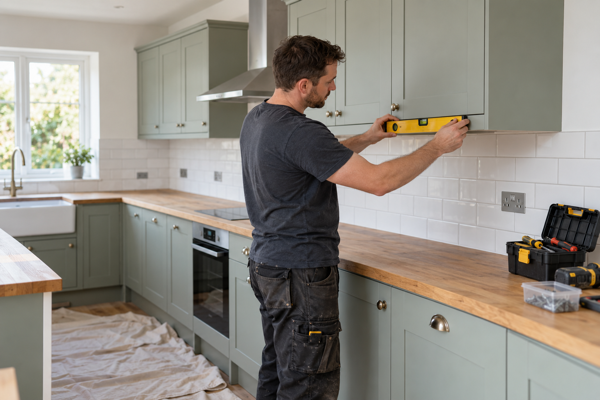
Kitchen cupboards get opened and slammed more than almost anything else in the house. Over time hinges work loose, doors drop out of line, drawer runners collapse under heavy pans and handles start to spin. Steam from the kettle and dishwasher can also swell the chipboard around fixings. A kitchen that looked tidy a few years ago can quickly start to feel tired, even if the units themselves are sound.
Handy Andrew repairs kitchen cupboards in homes and rentals across Newcastle, Gosforth, Heaton and North Tyneside. That covers adjusting and replacing hinges, fitting new drawer runners, repairing pulled-out screw holes, replacing doors and drawer fronts, and swapping tired handles for new ones.
For many people this is a good-value alternative to a new kitchen, particularly when the worktops and layout are fine. It also suits landlords who need a kitchen looking presentable for the next tenant. Where a cupboard has deeper problems, such as water damage from a leaking sink, Andrew will explain what can and cannot be repaired so you can decide what to do.
Most kitchen doors use concealed cup hinges with small adjustment screws. A door that is crooked or sticking out at the corner can often be brought back into line by adjusting these, with no parts needed. When the hinge itself is broken, a like-for-like replacement is usually easy to find, provided the cup size and opening angle are matched.
The trickier problem is when screws have pulled out of the cabinet side or the door, leaving crumbled chipboard. Simply putting a bigger screw in rarely lasts. Andrew repairs the hole properly with suitable filler or dowels, or moves the hinge plate slightly to fresh material, so the door holds firm. Doors on tall larder units may also benefit from an extra hinge.
If a few doors are damaged but the rest are fine, it may be possible to buy matching replacements, especially for popular ranges. For an older kitchen, a full set of new doors and handles can give a fresh look while keeping the carcasses and worktops. Andrew can fit doors you have ordered, drill them for hinges if they come undrilled, and line everything up neatly.
Things worth checking before ordering:
Sending measurements and photos first helps avoid ordering the wrong sizes.
Usually. Most kitchens use standard concealed hinges, and the brand and type are often stamped on the hinge itself. A close photo of the hinge and the cup hole helps. Soft-close and standard hinges can sometimes be mixed if you want to upgrade gradually.
Often yes. Collapsed drawers are usually caused by a broken runner or the drawer box coming apart at the joints. Replacement runners are available for most systems, and drawer boxes can be re-glued or replaced. If it is a branded system, a photo of the runner mechanism helps identify parts.
Generally, yes, because the carcasses, worktops, sink and appliances stay where they are. It works best when the units are in sound condition and you are happy with the layout. Andrew can fit the doors and handles, but you will need to choose and order them, or he can advise on measurements.
It depends on the damage. Swollen chipboard under a sink often cannot be restored, but the base panel or affected section can sometimes be replaced. First make sure the leak itself has been fixed, either by Andrew if it is a simple job or by a plumber, so the damage does not return.
Yes, swapping handles is a popular quick refresh. If the new handles have a different hole spacing, the old holes can be filled, although on painted or gloss doors a filled hole may still show. Choosing handles with the same spacing, or a backplate, gives the neatest result.
Tell Andrew what needs fixing – send a couple of photos and you’ll get a clear quote. One visit can sort several small jobs.
Doors, windows, loft hatches and letterboxes: a practical guide to stopping draughts in your Newcastle home without blocking the ventilation it needs.
The common repairs to sort between tenants, how to use inventory photos, and tips for student lets in Jesmond and Heaton. A practical checklist for landlords.
Brick, block, plasterboard or a Tyneside flat partition wall? How to tell what your wall is made of, which bracket suits it and how to tidy the cables safely.
Black mould, gaps and peeling silicone are signs your bath or shower needs resealing. Learn why mould returns, how long sealant takes to cure and when to worry.
Storm damage to your shed roof? How to decide between a patch repair and full re-felting, plus what to check on boards, doors and the base.
Curtain poles, blinds, TV mounting, flatpack and furniture anchors: the handyman jobs worth booking in your first week after moving in.