
Seasonal checklists
Draught Proofing Your Newcastle Home Before Winter
Doors, windows, loft hatches and letterboxes: a practical guide to stopping draughts in your Newcastle home without blocking the ventilation it needs.
Safe, easy loft access with a properly fitted ladder and a warm, sealed hatch.
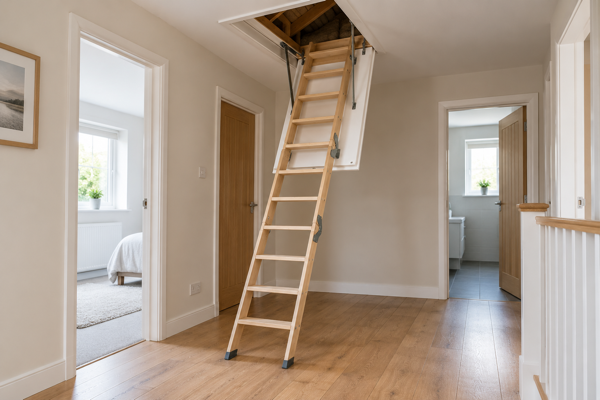
A loft is only useful if you can get into it safely. Balancing on a stepladder with a box of Christmas decorations, pushing up a heavy hatch that has been painted shut, is how a lot of household accidents start. A fitted loft ladder and a decent hatch make the space far easier and safer to use.
Andrew fits folding timber and aluminium loft ladders, sliding ladders and new insulated hatches for homes in Newcastle, Gosforth, Heaton and across North Tyneside and Northumberland. He checks the size of your existing opening, the floor-to-ceiling height and the space above, then recommends a ladder that will actually fit. Hatches are fitted with a proper frame, seal and insulation so they do not leak warm air into the loft.
What Andrew will not do is cut through ceiling joists or roof trusses to enlarge an opening. Those timbers hold the house together. If your hatch is too small for any suitable ladder and making it bigger means altering the structure, he will explain that honestly and point you towards a builder or structural engineer for that part.
Most folding loft ladders need an opening of roughly 55cm by 110cm or more, though compact models exist for smaller hatches. Andrew checks three things:
Many older Newcastle terraces have small square hatches. If the opening sits between joists and can be lengthened along them, that may be possible with proper trimming. If it would mean cutting a joist or truss, that is structural work and needs a builder and, usually, a structural check. Andrew will always tell you which situation you are in before you spend anything.
An uninsulated loft hatch is a weak spot in an otherwise insulated ceiling. Warm air escapes through the gaps, and moisture carried with it can condense on cold roof timbers. A properly fitted insulated hatch with a compression seal and a catch keeps the heat where you want it.
If you plan to use the loft for storage, avoid squashing the insulation with boards laid straight on the joists. Raised loft legs or platforms keep the insulation at full depth. Andrew can advise on this and fit small storage areas near the hatch, while leaving eaves ventilation clear so the roof space stays dry.
Sometimes. If the hatch can be extended along the line of the joists without cutting any, it may be possible with proper trimming. If enlarging it means cutting a ceiling joist or roof truss, that is structural work. Andrew will not do that, and will advise you to speak to a builder or structural engineer first.
You can, but it helps to check with Andrew first. Ladders are sized to the opening and ceiling height, and buying the wrong one is an easy mistake. Send your measurements and he will suggest suitable options, or supply a ladder as part of the quote if you prefer.
Both work well. Timber ladders usually feel sturdier underfoot and often come with an insulated hatch as a kit. Aluminium ladders are lighter and handy for smaller openings, especially sliding versions. The right choice depends on how often you use the loft, how much space you have and your budget.
Andrew can fit small storage platforms near the hatch using raised legs that keep the insulation at full depth. Large-scale boarding of a whole loft, or anything involving converting the space into a room, is a bigger job that may need building regulations, so he will advise you on that separately.
A straightforward ladder into an existing, suitable hatch is usually a part-day job. Fitting a new insulated hatch or trimming the opening adds time. Andrew will give you a realistic estimate when he quotes, so you know how long the landing will be out of action.
Tell Andrew what needs fixing – send a couple of photos and you’ll get a clear quote. One visit can sort several small jobs.
Doors, windows, loft hatches and letterboxes: a practical guide to stopping draughts in your Newcastle home without blocking the ventilation it needs.
The common repairs to sort between tenants, how to use inventory photos, and tips for student lets in Jesmond and Heaton. A practical checklist for landlords.
Brick, block, plasterboard or a Tyneside flat partition wall? How to tell what your wall is made of, which bracket suits it and how to tidy the cables safely.
Black mould, gaps and peeling silicone are signs your bath or shower needs resealing. Learn why mould returns, how long sealant takes to cure and when to worry.
Storm damage to your shed roof? How to decide between a patch repair and full re-felting, plus what to check on boards, doors and the base.
Curtain poles, blinds, TV mounting, flatpack and furniture anchors: the handyman jobs worth booking in your first week after moving in.